Small Bathroom Renovations 2026: The Ultimate Australian Guide


Most homeowners think they need a sledgehammer and a massive extension to fix a cramped ensuite, but small bathroom success is actually a game of millimetres where smart layout beats raw square footage every time. It’s a common frustration to feel claustrophobic in your own home, especially when you’re staring down the barrel of hidden costs for plumbing or struggling to find a reliable tradie for small bathroom renovations. We know you want a stylish, high-value powder room without the renovation headache or the fear of dodgy waterproofing.
This ultimate guide shows you how to master your project in 2026 while staying ahead of the latest regulations. You’ll discover how to navigate the new May 1, 2026 lead-free plumbing standards and ensure your tiler meets the 1,800mm waterproofing height required by the NCC 2022. We’ll break down why a typical budget reno sits between $8,000 and $15,000 and how the right WELS-rated fixtures can save a four-person household $232 on energy and water bills this year. Get ready to connect with local professionals and transform your space into a functional sanctuary in record time.
In the Australian property market, a “small” bathroom typically measures under five square metres. While larger homes often feature sprawling master suites, small bathroom renovations have become the most popular upgrade in 2026. This shift isn’t just about necessity; it’s about maximising every millimetre of high-value real estate. A well-executed ensuite or powder room can significantly boost a property’s market price, often returning more than the initial $8,000 to $15,000 investment. Modern homeowners are trading unused floor space for “functional luxury,” choosing premium lead-free brass tapware and smart mirrors over sheer square footage. Understanding bathroom design fundamentals helps you see that a compact room doesn’t have to feel like a compromise.
High-end finishes are no longer reserved for the main family bathroom. We’re seeing a massive trend where powder rooms and secondary ensuites get the five-star treatment with floor-to-ceiling tiling and custom stone joinery. Urban apartment living drives this innovation, forcing designers to think vertically and creatively to make every centimetre count. One standout trend in 2026 is the seamless integration of a European laundry within a small bathroom footprint, which combines a hidden washer and dryer behind sleek, moisture-resistant cabinetry to reclaim valuable floor space elsewhere in the home.
Renovating a tight space brings specific hurdles that larger projects often avoid. You might encounter a “tight-space” premium from tradies because moving materials and tools in a three-square-metre room is physically demanding and slows down the workflow. Proper ventilation is non-negotiable in small wet areas to prevent mould growth in high-humidity zones. You also need to stick to the National Construction Code (NCC) 2022 requirements for specific clearances around basins and toilets to ensure the room is actually usable. For example, the AS 3740 standard dictates that walls in wet areas must be waterproofed to a minimum height of 1,800mm. Getting these technical details right ensures your small bathroom renovations are compliant, safe, and built to last.
Smart layout is the backbone of any successful small bathroom renovations project. If you’re working with a footprint under 5sqm, you can’t afford a single wasted millimetre. The “Wet Room” concept is the ultimate Australian space-saver because it removes the need for bulky shower trays or hobbed entries. By waterproofing the entire floor area, you create a seamless flow that makes the room feel twice as large. However, this level of exposure means you must strictly follow Australian Standards for bathrooms, specifically AS 3740, to prevent structural damage from leaks.
In-line layouts, where the vanity, toilet, and shower sit along one wall, are often the most cost-effective because they simplify plumbing runs. Corner layouts work better for square rooms but can feel cramped if the fixtures are too large. Don’t forget the entry door; a standard hinged door steals nearly a square metre of floor space just to swing open. Installing a cavity slider (pocket door) gives that space back to you instantly. Use this checklist to ensure your layout remains functional:
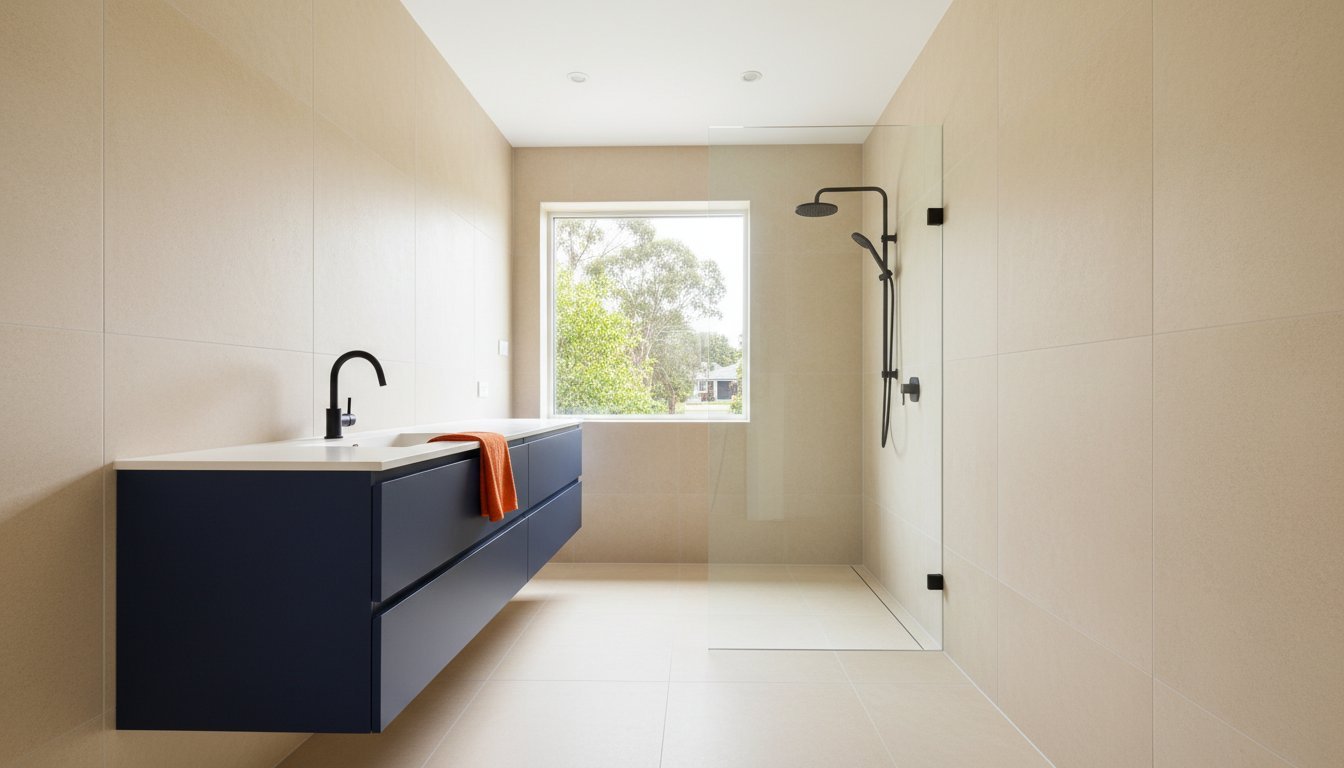
Floor visibility is a powerful psychological trick. When your eyes can see the tiles running all the way to the wall, your brain perceives the room as larger. Wall-hung toilets and floating vanities achieve this perfectly. Keep in mind that wall-hung systems often require a plumbing cavity or a “nib wall” to hide the cistern. If you’re unsure about your wall’s structural capacity or pipe placement, find a local tradie to check your studs before you buy any fixtures. As a bonus, floating designs make mopping a breeze since there are no awkward pedestal bases to scrub around.
Traditional shower cubicles act like a wall, chopping your room into smaller, claustrophobic boxes. Frameless glass panels or fully open walk-in showers remove these visual boundaries. This setup is excellent for accessibility, but it requires expert floor grading. Your tiler must ensure the “fall” toward the waste is precise so water doesn’t pool near your vanity or doorway. In a small bathroom renovations project, a single fixed glass panel is often cheaper and more effective than a complex door system that requires clearance to open.
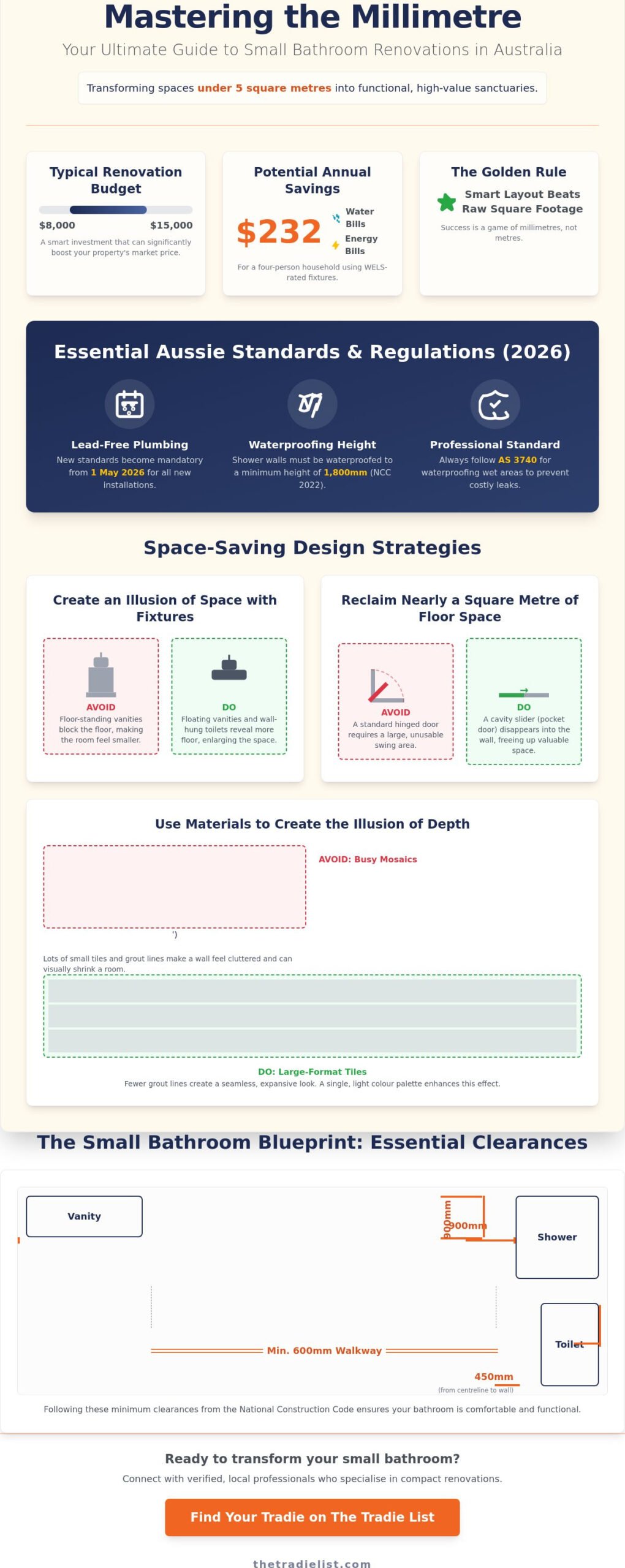
Choosing the right materials is about more than just aesthetics. It’s a tactical move to trick the eye into seeing more room than actually exists. Many homeowners mistakenly believe that small bathroom renovations require small tiles, but the opposite is often true. Tiny mosaics create a grid-like pattern with hundreds of grout lines, which clutters the visual field and makes walls feel like they’re closing in. By opting for large-format tiles, you reduce the number of breaks in the surface, creating a smoother, more expansive look that instantly opens up the room.
For a seamless finish, always specify rectified tiles. These are machine-cut to a perfect 90-degree angle, allowing your tiler to use ultra-thin 1.5mm grout lines. If your bathroom has a low ceiling, lay rectangular tiles vertically to draw the eye upward and create height. Conversely, horizontal placement makes a narrow room feel wider. In low-light Aussie bathrooms, skip the stark hospital whites. Instead, look for 2026’s trending palettes like “Silver Gum” or “Warm Shell” which provide brightness without the cold, clinical feel of traditional white tiles.
Lighting and mirrors are the heavy lifters of small bathroom renovations. A wall-to-wall mirror doesn’t just help you get ready; it literally doubles the perceived depth of the room. Pair this with 2026’s biggest trend: recessed LED strip lighting hidden under vanities or inside shower niches. This adds a layer of “ambient” light that makes fixtures appear to float. To get the best results, you need a layered lighting plan. Combine a bright “task” light for the mirror with soft “accent” lighting for evening use. This variety ensures your small space feels like a high-end spa rather than a cramped utility room.
Moving from a mood board to a construction site requires a surgical approach. For small bathroom renovations, the process must be precise because you don’t have the luxury of space to stage materials or store tools. It begins with a professional strip-out. While it’s tempting to grab a sledgehammer yourself, a pro knows how to remove old fixtures without damaging the structural studs or existing pipework. Once the room is back to its “bones,” the Rough-in phase begins. This is where your plumber and electrician install the internal components of your new lead-free taps and LED lighting before the walls are closed up.
Waterproofing is the most critical, non-negotiable stage. Under Australian law and the AS 3740 standard, your wet area must be a perfectly sealed vessel. If the membrane fails, your $15,000 investment will eventually lead to structural rot and mould. After the tiler finishes, the Fit-off phase brings the room to life as vanities, toilets, and shower screens are bolted into place. Before you take that first shower, ensure you book a Builder’s Clean. This isn’t just a quick wipe down; it’s a specialised service that removes caustic grout haze and fine construction dust from every nook and cranny.
Set a realistic 2026 budget before the first tile is cracked. A small Aussie renovation typically costs between $8,000 and $15,000 depending on your choice of materials. You must factor in a 15% contingency fund. Hidden plumbing issues or “creative” wiring from previous owners are common in older homes and only appear once the walls are off. To stay on track, order your fixtures at least eight weeks in advance. Supply chain delays can stall your project, and you don’t want to be stuck without a working toilet because a single tap is stuck in transit.
Coordination is the secret to a stress-free project. The sequence is strict: Demolition, then Plumber and Electrician for rough-in, followed by the Waterproofer. The waterproofer is your MVP. They need a clean, dry site and usually require 24 to 48 hours of drying time for the membrane to cure before the tiler can start. Homeowners often forget these mandatory waiting periods, which are essential for a compliant build. To keep your project moving without delays, find local tradies who are experienced in managing tight residential timelines and multi-trade handovers.
It’s a common mistake to assume that a smaller room means an easier job. In reality, small bathroom renovations require a higher level of technical skill because there is zero margin for error. When you’re working in a 3sqm ensuite, a tiler who is off by just three millimetres can throw out the entire vanity alignment or cause water to pool in the wrong corner. You need a team that understands how to navigate tight physical constraints while meeting the strict NCC 2022 requirements. Hiring a cut-price operator often leads to botched waterproofing or plumbing that doesn’t meet the new May 1, 2026 lead-free standards, costing you thousands in repairs later.
Using a verified directory like The Tradie List removes the guesswork from your project. We bridge the gap between homeowners and skilled professionals who actually want to take on compact projects. Look for the “Verified Professional Badge” on a tradie’s profile. This is our digital handshake that tells you the professional has been vetted, allowing you to move forward with confidence. Whether you’re paying a Sydney plumber’s rate of $120 to $160 per hour or a tiler’s square metre rate, you want to know that every dollar is buying expert-level precision.
Don’t just take a quote at face value. Before signing a contract, ask your tiler these three specific questions to gauge their experience with tight layouts:
Always verify credentials before work begins. It’s easy to check an ABN and licence number on national registries like the ASIC database or your state’s building commission website. A legitimate tradie will have no problem providing these details immediately. Seeing their previous “small space” work is also vital; it proves they can produce high-end finishes even when they’re working in a literal cupboard.
Our platform is designed for speed and local connectivity. We understand that busy homeowners don’t have hours to chase quotes from people who never call back. The Tradie List connects you with local experts in minutes, making it simple to compare value across multiple professionals. You get visibility into the best talent in your area without the stress of cold-calling. If you’re ready to turn that cramped powder room into a designer sanctuary, Find a Tradie Australia to start your reno today and get the job done right the first time.
Transforming a cramped ensuite into a high-value sanctuary doesn’t require a massive extension. By focusing on smart layouts like wet rooms and selecting materials that trick the eye, you can achieve a designer look in any space under 5sqm. Success in small bathroom renovations relies on the technical details. You must ensure your project meets the 1,800mm waterproofing height required by AS 3740 and uses lead-free products as mandated by the May 1, 2026 standards. These choices help a four-person household save $232 on water and energy bills this year while protecting your property value.
Don’t let the stress of finding reliable help stall your progress. You can access thousands of verified Australian tradies who specialise in compact projects. Our directory offers stress-free connections to licensed professionals across plumbing, tiling, and electrical work in minutes. Take the first step toward your new sanctuary and enjoy a seamless, professional experience from start to finish.
Find a licensed tradie for your small bathroom renovation now!
A budget-friendly small bathroom renovation in 2026 typically costs between $8,000 and $15,000. If you’re aiming for a mid-range finish with higher-quality fittings, expect to pay between $15,000 and $35,000. According to 2023 HIA data, the national average for all bathroom sizes is around $26,000, but compact spaces allow you to spend more on premium materials like lead-free brass tapware while keeping the total cost low.
Expect your project to take between 14 and 21 days from the initial strip-out to the final fit-off. While the physical work happens quickly, you must account for mandatory curing times. Waterproofing membranes require 24 to 48 hours to dry properly before tiling can begin, and grout needs similar patience to ensure a leak-proof finish.
You don’t usually need a permit for “like-for-like” small bathroom renovations where the layout stays the same. However, you must obtain council approval if you’re moving structural walls or relocating major plumbing lines. All work must comply with the National Construction Code (NCC) 2022, so always check with your local council before you start demolition.
No, you shouldn’t attempt your own waterproofing because it is a high-risk trade that requires a specific licence in most Australian states. Under AS 3740, waterproofing must be perfect to prevent structural rot. Licensed tradies provide a certificate of compliance, which is essential for your home insurance and future resale value.
The “In-line” layout is the most efficient choice for narrow spaces. By placing the vanity, toilet, and shower along a single wall, you keep the opposite side clear for movement. Pair this with a cavity slider door to reclaim the square metre of space usually lost to a traditional door swing.
Find a reliable tiler by using The Tradie List to connect with local professionals in minutes. Look for tradies with the “Verified Professional Badge” and ask to see their portfolio of small ensuite jobs. Since an experienced tiler typically charges around $60 per hour, comparing multiple quotes ensures you get the best value for your project.
Yes, updating a tired bathroom is one of the most effective ways to increase your property’s market price in 2026. Modern buyers prioritise “move-in ready” homes with water-efficient WELS-rated fixtures. A four-person household can save $232 annually with these upgrades, making your home a more attractive investment for budget-conscious buyers.
Porcelain tiles and stone composite surfaces are the most durable options for high-traffic wet areas. Porcelain is denser and less porous than ceramic, making it resistant to moisture and stains. For tapware, ensure all products meet the mandatory May 1, 2026 lead-free standards to guarantee longevity and safety for your family.