21 Essential Questions to Ask a Builder Before Hiring: The Ultimate Homeowner’s Checklist


How much would you pay to ensure your A$450,000 home build doesn’t end up as a viral horror story on the evening news? Most homeowners feel a knot in their stomach at the thought of hiring a “cowboy” who disappears halfway through the job. You aren’t alone if you feel overwhelmed by technical jargon or worry about the specific questions to ask a builder before hiring. It’s completely normal to want certainty before signing a contract that involves your life savings and your family’s future.
We’ve created this guide to give you total control over your construction journey. This comprehensive checklist helps you separate the true professionals from the dodgy operators in minutes. You’ll learn how to verify insurance, spot red flags in quotes, and ensure your project stays on track. This article provides a clear framework to interview potential tradies with confidence. It ensures your next Australian project is a stress-free success from the first sod turn to the final handover.
The paperwork phase is the most critical hurdle for any Australian build. It’s where you separate the professional tradies from the cowboys. While a glossy portfolio looks great, it won’t protect your life savings if the project stalls. These are the non-negotiable questions to ask a builder before hiring to ensure your investment stays safe from the start.
You must distinguish between a registered business and a licenced builder. An ABN simply means they can invoice you; a licence proves they have the technical skills and legal right to carry out structural work. Never accept a builder who says they’re “working under someone else’s licence.” This practice, often called licence hanging, is a major red flag. If the person on your site isn’t the one legally responsible, your insurance coverage will likely vanish the moment a claim is filed. It’s a risk that can lead to total financial loss.
Start by asking for their licence number immediately. You can verify this in seconds through your state’s building commission, such as the VBA in Victoria or Fair Trading in NSW. Ensure the licence is active and covers the specific class of work you need. Understanding what a general contractor does clarifies why they must hold specific insurances to manage site risks legally. Without these, you’re the one left vulnerable.
Financial stability is just as important as building skill. Ask directly about past or current building commission disputes. In Queensland alone, the QBCC manages thousands of dispute lodgements annually; you want a builder with a clean record. Check for a history of company liquidations through ASIC. A builder who shuts down one business only to open another the next week is a “phoenixing” risk you cannot afford. These questions to ask a builder before hiring help you spot a pattern of failure before it hits your backyard.
A builder’s relationship with their suppliers is a leading indicator of their solvency. If they aren’t paying their local timber yard or brick supplier on time, your materials won’t arrive. Reliable tradies maintain healthy credit lines because they pay their bills. Ask for a trade reference from a major supplier to confirm they’re in good standing. It’s a simple check that provides massive peace of mind.
Don’t get blinded by a glossy Instagram feed. A curated gallery of finished kitchens doesn’t show you the structural issues or budget blowouts hidden behind the plaster. You need to dig deeper. One of the most vital questions to ask a builder before hiring involves their specific technical history. A builder who excels at sleek, minimalist apartments might struggle with the complex timber framing of a heritage Queenslander renovation. Expertise isn’t universal; it’s specific.
Ask to visit a site that’s currently under construction. A finished home hides mistakes, but a live site reveals the truth. Look for a tidy workspace. If you see offcuts scattered everywhere and tools left in the rain, that lack of discipline will likely show up in your final invoice. A 2023 industry report indicated that over 60% of building disputes in Australia stem from poor site management and communication issues. Seeing how they organise their daily workflow tells you more than a thousand professional photos ever could.
Distinguish between sales talk and technical expertise. A salesperson focuses on “luxury finishes” and “lifestyle.” A real builder talks about drainage, load-bearing spans, and BAL (Bushfire Attack Level) ratings. You want the person who understands the soil conditions of your specific suburb, not just the person who can sell a dream.
Ask for three examples of jobs completed in the last 24 months that match your project’s scale and complexity. If you’re planning a high-spec sustainable build, a standard volume builder isn’t the right fit. Inquire about the specific challenges they faced on those jobs. If they claim everything went perfectly, they’re likely being economical with the truth. Real building involves solving problems. You need a tradie who can explain how they managed a 10% price hike in timber or a 14-day weather delay without compromising the build quality.
In more complex scenarios, such as developments requiring specific council approvals for traffic flow or parking, ask if the builder has experience working with specialist engineers. Reviewing technical resources like mltraffic.com.au can help you understand the types of parking demand assessments that might be required for your project to proceed smoothly.
Follow the “Three-Reference Rule.” One happy client could be the builder’s best mate, but three happy clients suggest a pattern of success. Call these references instead of just reading an email. Ask specific questions:
Listen for “coached” answers. If a reference sounds like they’re reading from a script, ask for a different contact. Genuine customers will mention small frustrations but explain how the builder resolved them. Finding a reliable professional who knows your local area is easy when you search for a qualified tradie through our directory.
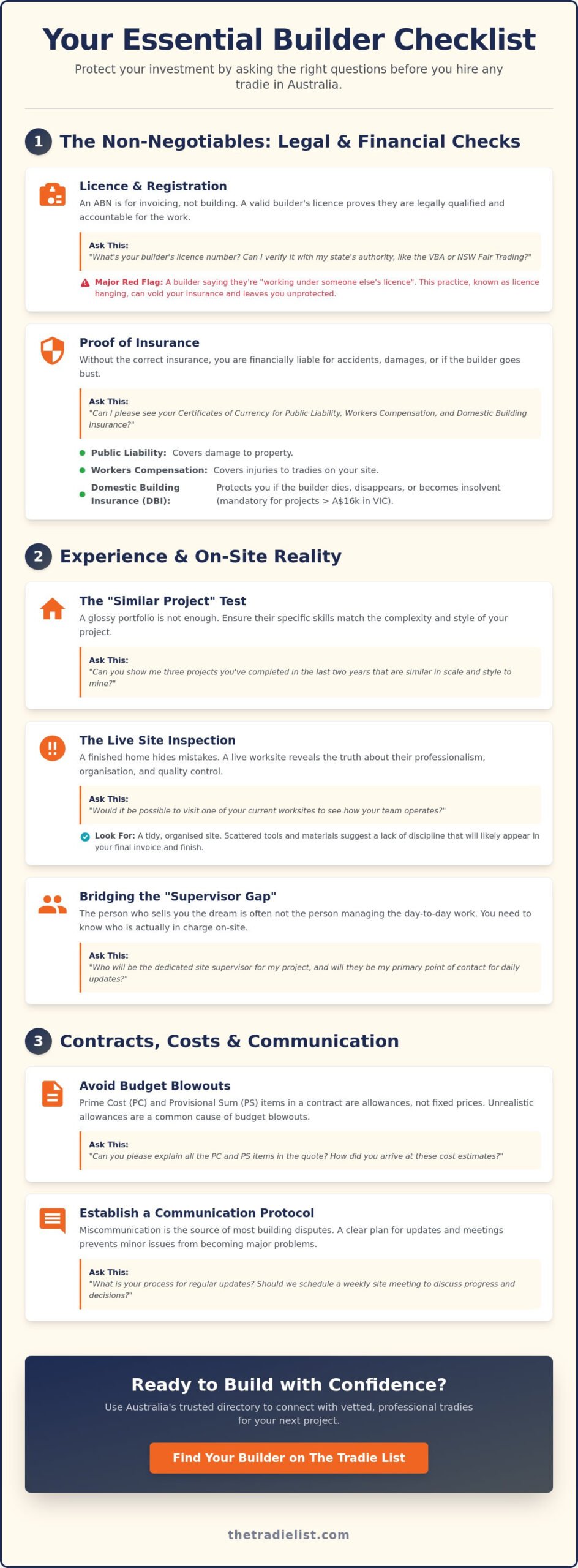
You might spend hours chatting with a builder in a polished showroom, but that person rarely picks up a hammer on your site. This is known as the “supervisor gap.” It’s a common trap where the sales-focused builder you meet hands the keys to a junior site manager you’ve never spoken to. One of the most critical questions to ask a builder before hiring is: “Who will be my daily point of contact on-site?”
A builder’s current workload directly impacts your project’s finish. Industry standards suggest a single supervisor shouldn’t manage more than 5 to 8 builds at once. If your assigned supervisor is juggling 12 different sites across the suburb, your questions will go unanswered and mistakes will slip through the cracks. Ask for a specific number of active projects they’re currently running to gauge their capacity.
Your daily point of contact should be a qualified site foreman or the registered builder. Ask how often the person holding the building licence actually steps onto the slab. In many Australian states, the registered builder must provide “adequate supervision,” but this definition is often stretched. A quality builder schedules a formal site meeting at least once a fortnight. This keeps the construction schedule on track and ensures you aren’t left guessing about the next stage of the build.
The best builders don’t just hire whoever is cheapest on a Tuesday morning. They rely on a consistent “tradie base” of electricians, plumbers, and chippies. These long-term relationships are the backbone of a high-quality home. When a builder works with the same team for 5 years or more, the tradespeople understand the expected standard and don’t want to let the builder down.
Site safety and cleanliness act as a proxy for the final build quality. Walk past one of their current active sites. If you see lunch wraps and offcuts scattered everywhere, it’s a sign of poor discipline. SafeWork Australia reports show that organised sites have fewer delays and higher safety compliance. A builder who organises a clean site usually organises a high-quality build. Don’t settle for a messy workspace; it’s a red flag that the same lack of care will be applied to your waterproofing or structural framing.
Signing a building contract is the biggest financial commitment you will make during your project. You want a document that leaves zero room for “he said, she said” arguments. In Australia, most reputable builders use standard contracts from the Housing Industry Association (HIA) or Master Builders Association (MBA). These documents are designed to be fair, but you must understand the specific variables that can blow your budget apart.
The reality of a “Fixed Price” contract in the current market is complex. While the base price stays the same, “Rise and Fall” clauses allow builders to pass on significant material price hikes for items like timber or steel. Check your contract for these clauses. Ensure any variations to the original plan are documented in writing and signed by both parties before the work begins. Verbal agreements often lead to disputes during the final progress payment.
Prime Cost (PC) items and Provisional Sums (PS) are the two areas where budgets usually fail. A PC item is a budget allowance for a specific fixture, such as a A$2,000 allowance for a freestanding bathtub. If you choose a tub that costs A$2,500, you pay the difference plus the builder’s margin. A Provisional Sum is an estimate for labour and materials where the final cost is unknown, such as site excavation or landscaping.
One of the most important questions to ask a builder before hiring is how they handle project delays. Your contract should specify a clear start date and a fixed number of days for completion. Professional builders factor in “allowable delays” for public holidays and average rainfall based on Bureau of Meteorology data. If the builder exceeds the contract period without a valid reason, Liquidated Damages come into play.
Liquidated Damages are a pre-determined amount, often between A$250 and A$500 per week, that the builder pays you to cover your extra costs, like rent or storage fees. It is not a penalty; it is a genuine estimate of your loss. Ensure this figure is realistic before you sign. You should also ask how the builder manages material shortages, as these are no longer considered “unforeseen” events in the current construction climate.
Ready to find a reliable professional who respects your budget and timeline? Connect with top-rated local tradies on The Tradie List today.
Your builder will be a major part of your life for six to eighteen months. It’s a long-term relationship that requires more than just a signed contract. While technical skills are vital, the “gut feel” you get during your initial meeting is a valid data point. If a builder is slow to return calls now, they won’t magically become more communicative once they have your deposit. Trust your instincts. If the rapport feels strained during the interview, it will likely stay that way when the pressure of the build ramps up.
Every construction project involves hundreds of moving parts. In Australia, a standard residential build can involve over 20 different sub-contractors. With so many variables, clear communication is the only thing that prevents small hiccups from becoming expensive disasters. You need an efficient connector who values your time and your budget.
Establish a protocol before the first brick is laid. Ask which tools they use to stay in touch. Do they prefer email, phone calls, or project management software like CoConstruct or Buildertrend? These platforms are excellent for tracking variations and daily logs. You should expect formal progress updates and site photos at least once a fortnight. Lock in a regular site meeting schedule too. Meeting on-site every two weeks ensures you see the progress with your own eyes and can address concerns before they get covered by plasterboard.
Mistakes happen on 100% of construction sites. The difference between a professional and a cowboy is how they fix them. One of the most telling questions to ask a builder before hiring is: “Can you tell me about a time a client wasn’t happy and how you fixed it?” A reliable tradie won’t get defensive; they’ll explain their process for making things right. Check your contract for formal dispute resolution clauses. In Victoria, you might look at the DBDRV; in NSW, it’s Fair Trading. However, a good builder aims to solve issues on-site long before legal bodies get involved.
Once you’ve finished the interviews, it’s time to finalise the deal. Review the quotes, check their Home Building Compensation (HBC) insurance, and verify their licence one last time. When you find the right fit, you’ll feel confident moving forward. Ready to find a pro? Search verified builders on The Tradie List today and get your project moving in minutes.
Choosing the right partner for your project shouldn’t feel like a gamble. You’re now equipped with the 21 essential questions to ask a builder before hiring to protect your home and your bank account. Industry figures suggest that roughly 1 in 4 Australian building disputes arise from poor communication; these questions ensure you aren’t left in the dark. By verifying state-required licences and locking in a “no surprises” framework, you set a professional standard from day one.
Don’t leave your renovation to chance when you can access a network of experts who are ready to work. Find and compare licenced builders in your area on The Tradie List to see how easy it is to find a pro. Our platform features Verified Professional Badges for peace of mind and a transparent directory with real customer reviews. You can connect with local Aussie tradies in minutes and start your project with a team you actually trust. It’s time to turn those blueprints into a reality.
Before you can build, you need the right location. To ensure you purchase a property with the best development potential in Melbourne, learn more about Your Australian Property Buyers Agents.
Check your builder’s licence by searching the public register managed by your state’s building authority, such as the QBCC in Queensland or the VBA in Victoria. You must confirm the licence is “Active” and covers the specific type of work you need. These registers also show if a tradie has faced any disciplinary action or has current insurance. It’s one of the most critical questions to ask a builder before hiring to ensure your project is protected.
Australian state laws strictly limit how much a builder can request as an upfront deposit. In New South Wales and Queensland, the maximum deposit for residential work over A$20,000 is 10 per cent of the total contract price. For smaller jobs under A$20,000, the limit remains 10 per cent. Don’t pay more than these statutory limits before work begins on your site.
Don’t automatically pick the cheapest quote because it often leads to hidden costs or poor workmanship later. A price that’s 15 to 20 per cent lower than other bids might indicate the tradie missed key items like site costs or council fees. Compare every line item in the quotes to see exactly what’s included. Focus on finding a balance between a fair price and a proven track record of quality.
Contact your Home Building Compensation insurer immediately if your builder becomes insolvent or disappears. This insurance is mandatory for most residential projects over A$20,000, depending on your state’s specific legislation. The policy provides cover for finishing the work or fixing defects, usually up to a limit of A$340,000 in NSW or A$300,000 in Victoria. Keep your insurance certificate in a safe place from day one.
You can change materials after signing, but you’ll need to complete a written “variation” document. This process records the change in cost and any delays to the completion date. Builders often charge an administration fee, sometimes around A$250 to A$500, plus the price difference for the new materials. Get the new price in writing before the tradie orders the replacement items to avoid budget blowouts.
A maintenance period, or defects liability period, is a set timeframe after practical completion where the builder must fix any minor faults. This period typically lasts for 13 to 26 weeks, as specified in standard HIA or Master Builders contracts. It gives the house time to settle through different weather conditions. Make a list of any sticking doors or small cracks and present them to your tradie before this period ends.
Hire an independent building inspector to review work at key stages like the slab, frame, and final handover. Even if you trust your tradie, an expert third-party eye catches errors that might be overlooked during a busy build. These inspections provide an unbiased report on whether the work meets the National Construction Code. Spending roughly A$500 per inspection stage can save you thousands in future repairs.
Refer to the “suspension of works” or “termination” clauses in your contract if your builder stops attending the site. Send a formal “Notice of Default” via registered post to demand work resumes within a specific timeframe, often 10 to 14 days. This is a vital step before you can legally terminate the agreement. This situation highlights why knowing the right questions to ask a builder before hiring is essential for managing expectations.